
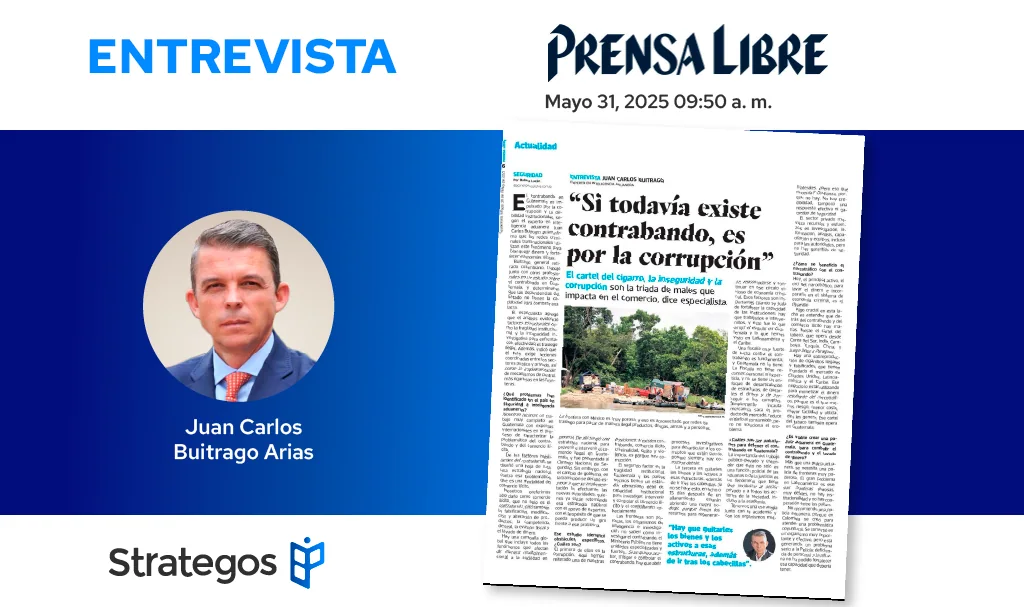
Smuggling in Guatemala is driven by corruption and institutional weakness, according to customs intelligence expert Juan Carlos Buitrago, who warns that transnational criminal networks use this phenomenon to launder money and strengthen illicit economies.
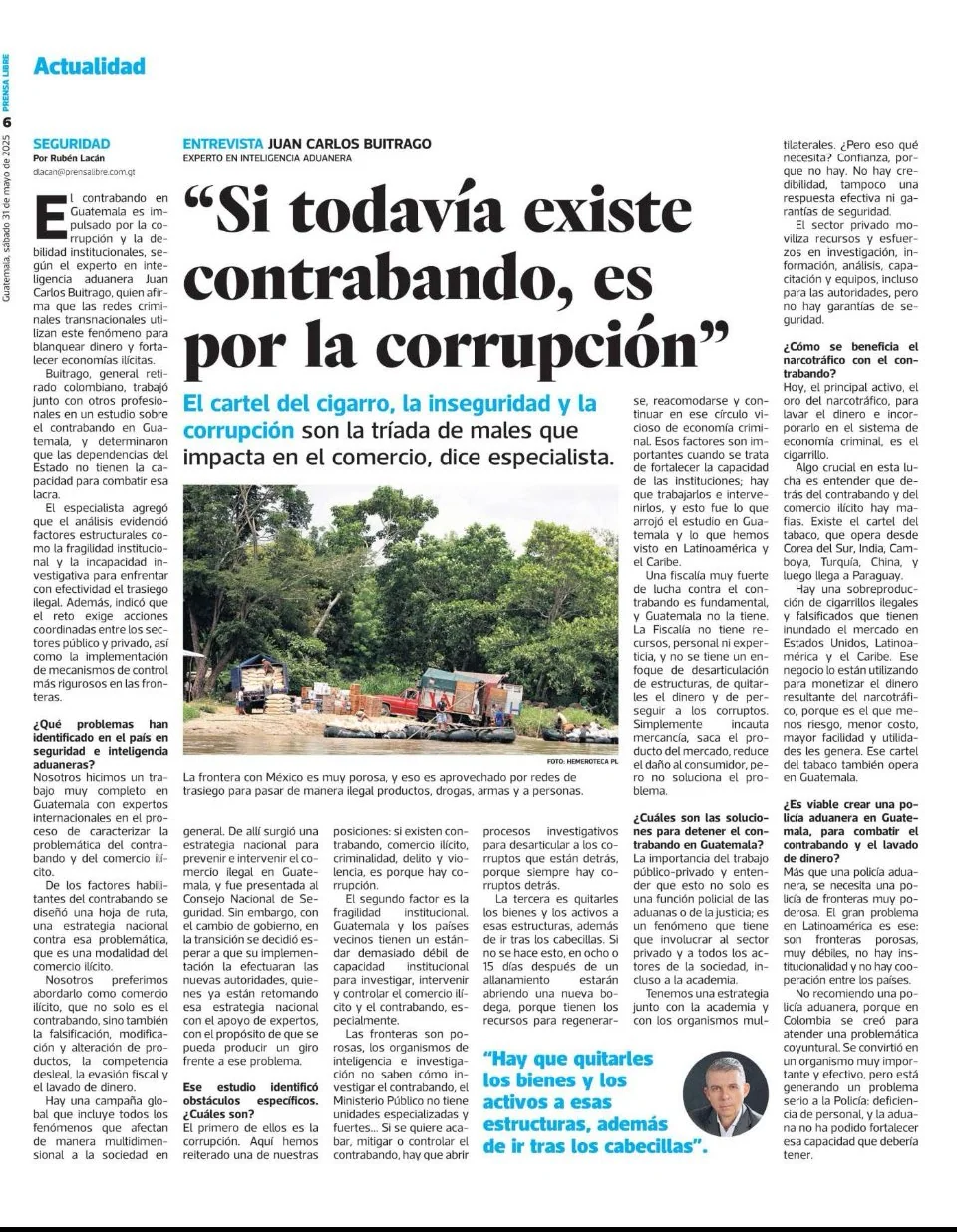
Smuggling and illicit trade represent one of the most complex challenges for Guatemala's security and economy. These phenomena not only affect tax collection and the competitiveness of the formal market, but also feed organized crime networks, says Juan Carlos Buitrago, a Colombian expert in security and customs intelligence.
Buitrago worked with other professionals on a study of smuggling in Guatemala and determined that State institutions lack the capacity to combat this problem.
The specialist added that the study showed structural factors such as institutional fragility and the lack of investigative capacity to confront smuggling effectively. He also indicated that the challenge demands coordinated action between the public and private sectors, as well as the implementation of more rigorous control mechanisms at the borders.
Buitrago commented that the situation is aggravated by the participation of transnational criminal structures that use smuggling as a means of money laundering.
What problems have you identified in the country in terms of security and customs intelligence?
We did a very comprehensive piece of work in Guatemala with international experts in the process of characterizing the problem of smuggling and illicit trade.
Traditional Guatemalan cuisine
From the enabling factors of smuggling, a roadmap was designed, a national strategy against that problem, which is one form of illicit trade.
We prefer to approach it as illicit trade, which is not only smuggling, but also counterfeiting, modification and alteration of products, unfair competition, tax evasion and money laundering.
There is a global campaign that includes all the phenomena that affect society in general in a multidimensional way. From it emerged a national strategy to prevent and intervene in illicit trade in Guatemala, and it was presented to the National Security Council. However, with the change of government, during the transition, it was decided to wait for its implementation to be carried out by the new authorities, who are already taking up that national strategy again with the support of experts, with the aim of turning things around on that problem.
That study identified specific problems. What are they?
The first of them is corruption. Here we have reiterated one of our positions: if there is smuggling, illicit trade, criminality, crime and violence, it is because there is corruption.
The second factor is institutional fragility. Guatemala and its neighboring countries have a far too weak standard of institutional capacity to investigate, intervene in and control illicit trade, and smuggling in particular.
Borders are porous, intelligence and investigative agencies don't know how to investigate smuggling, the Public Prosecutor's Office doesn't have specialized, strong units... If you want to end, mitigate or control smuggling, you have to open investigative processes to dismantle the corrupt people behind it, because there are always corrupt people behind it.
The third is to strip those structures of their assets and property, in addition to going after the ringleaders. If this is not done, eight or fifteen days after a raid they will be opening a new warehouse, because they have the resources to regenerate, regroup and continue in that vicious circle of criminal economy. These factors are important when it comes to strengthening the capacity of institutions; they have to be worked on and intervened, and this is what the study in Guatemala showed and what we have seen in Latin America and the Caribbean.
A very strong prosecutor's office devoted to fighting smuggling is essential, and Guatemala does not have one. The prosecutor's office has no resources, personnel or expertise, and it does not have an approach of dismantling structures, taking their money away and pursuing the corrupt. It simply seizes merchandise, takes the product off the market, reduces harm to the consumer, but does not solve the problem.
What are the solutions for smuggling in Guatemala?
The importance of public-private work and understanding that this is not only a police function of customs or the justice system; it is a phenomenon that has to involve the private sector and all actors of society, including academia.
We have a strategy together with academia and with multilateral organizations.
But what does that need? Trust, because there is none. There is no credibility, nor an effective response, nor security guarantees.
The private sector mobilizes resources and efforts in research, information, analysis, training and equipment, even for the authorities, but there are no security guarantees.
How does drug trafficking benefit from smuggling?
Today the main asset, the gold of drug trafficking, for laundering money and incorporating it into the criminal economy system, is the cigarette.
Something crucial in this fight is to understand that behind smuggling and illicit trade there are mafias. There is a tobacco cartel that operates from South Korea, India, Cambodia, Turkey and China and then arrives in Paraguay to traffic it across the continent.
There is an overproduction of illegal and counterfeit cigarettes that have flooded the market in the United States, Latin America and the Caribbean. They are using that business to monetize drug-trafficking money, because it is the one that generates the least risk, lowest cost, greatest ease and profits for them. That tobacco cartel also operates in Guatemala.
Is it viable to create a customs police in Guatemala to combat smuggling and money laundering?
More than a customs police, what is needed is a very powerful border police. The big problem in Latin America is exactly that: borders are porous and very weak, there is no institutional framework and there is no cooperation between countries.
I don't recommend a customs police, because in Colombia it was created to address a short-term problem. It became a very important and effective body, but it is creating a serious problem for the police: personnel shortages, and customs has not been able to build up the capacity it should have.
How can we prevent police officers from being part of that smuggling system and from being part of corruption?
You have to give police officers guarantees first. If the institution doesn't give them legal guarantees of security and protection so that they can do their work, there will be no change.
Oversight mechanisms must be maintained, along with a very strong anti-corruption control mechanism, and the economic assets of officials must be monitored, especially those in high-risk positions because of their function, such as customs inspectors.
The polygraph and reliability tests must be kept, so that the police officer knows we are evaluating him every six months and that if he doesn't pass the polygraph, he can't stay in his post.
Article written by Rubén Lacán, originally published in prensalibre.com. on May 31, 2025: https://www.prensalibre.com/guatemala/justicia/la-fragilidad-institucional-impide-combatir-el-contrabando-en-guatemala-asegura-experto-en-seguridad/