
Summary
Abstract. This article examines illicit trade and unfair competition in printer cartridges and inks in Mexico through monitoring by the CIMA platform, cross-checked against official foreign trade statistics, US sanctions records and studies by international organisations. The mirror gap for headings 3215 and 8443 ranged between USD 323 million and USD 468 million per year from 2022 to 2025. In a single month, an initial set of risk criteria identified at least USD 582,000 in suspicious transactions and signals throughout the supply chain, from foreign suppliers to online sales. The article argues that the convergence of intellectual property and forced labor, reinforced by the 2026 US tariff, opens a path for action that remains little explored in the sector.
Keywords: illicit trade; counterfeiting; mirror statistics; forced labor; USMCA; printing consumables.
Introduction
Trade in counterfeit goods is usually studied as an intellectual property issue, while forced labor is treated as a labor and human rights issue. In Mexico’s printing consumables market, the two intersect: the same trade flows that concentrate statistical discrepancies include suppliers sanctioned in the United States for forced labor. This article asks what the available evidence says about the scale and channels of irregular trade in cartridges and inks in Mexico, and what the new regulatory framework on forced labor means for controlling it.
The economic significance is considerable. In 2024, Mexico imported USD 1.943 billion in printing machinery and parts (heading 8443), with China as the main country of origin, and USD 309 million in inks (heading 3215) (Secretaría de Economía [SE], n.d.-a, n.d.-b). Worldwide, counterfeit and pirated goods accounted for up to 2.3% of trade in 2021, approximately USD 467 billion (Organisation for Economic Co-operation and Development [OECD] & European Union Intellectual Property Office [EUIPO], 2025).
Conceptual framework and sources
Four related phenomena should be distinguished. Counterfeiting involves reproducing a registered trademark without authorisation. The parallel or grey market trades genuine products outside authorised channels; it may or may not be lawful, depending on the applicable exhaustion-of-rights regime. Compatible and remanufactured consumables are, in principle, lawful if they do not use the trademark or infringe patents. Forced labor, finally, is a condition of production rather than of the product: a genuine, compatible or counterfeit cartridge may be linked to it. Conflating these categories leads to overestimating the illicit phenomenon.
The analysis combines September 2026 import records under headings 3215 and 8443 with mirror analysis, the cross-checking of importers and suppliers against sanctions lists through Strategos BIP’s CIMA platform, and the tracking of online listings. The resulting figures are initial estimates that require further validation. They are cross-checked against Data México, the US Federal Register, decisions of the United States International Trade Commission (USITC), and studies by the OECD and EUIPO.
Mirror analysis compares what one country reports importing from a partner with what that partner reports exporting to it. The International Monetary Fund (IMF, 2023) recommends it to customs administrations as a risk management tool for detecting undervaluation, tariff misclassification, false origin or smuggling, but cautions that a discrepancy is an indicator rather than proof of fraud: it can also arise from classification or exchange-rate differences, goods in transit between reporting periods, re-exports, and the distinction between origin and provenance. Global Financial Integrity (GFI, 2020), which applies this method to trade data reported to the United Nations, ranked Mexico as the developing country with the second-largest average gap in its trade with advanced economies between 2008 and 2017, at approximately USD 62.9 billion per year. At the product level, Fisman and Wei (2004) found that, in trade between Hong Kong and China, a one-percentage-point increase in tariffs was associated with 3% more evasion, partly through reclassification into products subject to lower duties.
Findings
This section shows how applying an initial, partial set of risk criteria identified at least USD 582,000 in suspicious transactions in a single month, along with potential offenders throughout the supply chain, from a foreign supplier to digital retailing. The identification of importers or brands does not, by itself, constitute evidence of irregularities: it is necessary to verify whether the operators belong to authorised distribution chains.
Scale and trend of the mirror gap in a risk country: the case of Malaysia
The net difference between the values reported by Mexico and by its partners under headings 3215 and 8443 was USD 419.9 million in 2022, fell to USD 323.4 million in 2023 and USD 335.8 million in 2024, and rose to USD 468.1 million in 2025, an increase of 44.7% compared with 2023 (Figure 1, panel A). As an indication of scale, the 2024 gap is equivalent to 14.9% of the imports under both headings recorded in Data México that year, although the two calculations do not necessarily share the same basis. The Malaysia–Mexico corridor accounts for an aggregate difference of USD 34.9 million, and Malaysia appears as the country of origin in 15 of the 28 risk observations, making it a monitoring priority.
That priority should be interpreted cautiously. Malaysia hosts legitimate plants operated by authorised printing-consumables manufacturers; at least one major global brand has operated an ink-supplies plant in Penang since 2016 ("HP Inc opens new ink-manufacturing facility", 2016). It is therefore plausible that some of the flow originating in Malaysia consists of genuine products and that the gap reflects triangulation within authorised supply chains rather than diversion or counterfeiting.
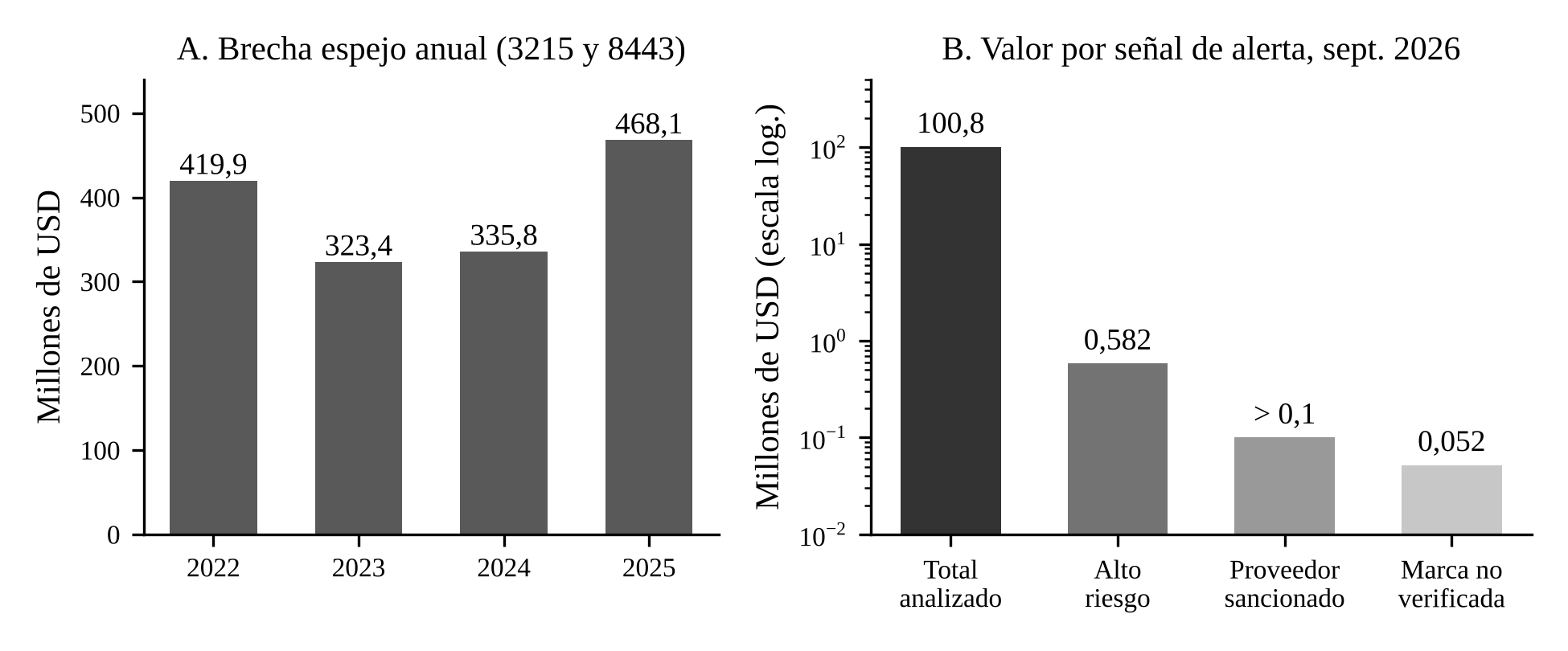
Note. Authors’ calculations using CIMA platform data. Panel A: net difference between imports reported by Mexico and exports reported by its partners under headings 3215 and 8443. Panel B, on a logarithmic scale: signal categories may overlap. Initial estimates requiring further validation.
High-risk transactions associated with goods descriptions and country of origin
In September 2026, 11,766 import records with a customs value of USD 100.8 million were analysed. Using only three initial criteria—goods descriptions associated with recognised brands but declared by operators outside those companies, high-risk countries of origin, and links to sanctioned entities—transactions worth approximately USD 582,000, or 0.58% of the value analysed, were classified as high risk. This is a floor rather than a ceiling: the set of criteria is partial and does not include, for example, analysis of anomalous unit prices or newly incorporated importers.
Potential counterfeiting or diversion from a specific brand’s supply chain
Within that universe, approximately USD 52,000 in imports mentioning a specific brand were identified across five trading relationships; the importers had no publicly verifiable connection to its authorised supply chain. Three explanations are possible: counterfeiting, a parallel market in genuine products, or authorised distributors that do not appear in public sources. Distinguishing among them requires cross-checking the names against the rights holder’s distribution network.
Alert signals relating to forced labor
Cross-checking against sanctions lists detected more than USD 100,000 in imports by two Mexican operators associated with the same supplier, Ninestar Corporation. The supplier information is supported by an official record: the US Department of Homeland Security (DHS, 2023) added Ninestar and eight Zhuhai-based subsidiaries to the Uyghur Forced Labor Prevention Act (UFLPA) Entity List, effective June 12, 2023, prohibiting the entry of their products into the United States. The company also has a history of patent litigation with original equipment manufacturers: in investigation 337-TA-723, the USITC (2015) denied a Ninestar subsidiary’s request to vacate a seizure and forfeiture order covering cartridges. What the evidence does not establish is that the specific shipments received in Mexico involved forced labor; the US designation operates as a presumption for its own market, not as proof in Mexico.
Digital channel
In the online channel, analysis of listings identified a seller offering abnormally low prices compared with official benchmarks, more than 90 ink listings resembling genuine products from a recognised brand, participation in sales groups on social media, and a probable physical outlet in a technology shopping centre in central Mexico City. A verified purchase would make it possible to establish whether the product is counterfeit, diverted genuine stock or compatible. This pattern is consistent with what the OECD and EUIPO (2025) describe globally: online sales, small shipments—which account for nearly 65% of seizures—and assembly close to the final market.
Comparative regulatory dimension
Article 23.6 of the United States–Mexico–Canada Agreement (USMCA) requires the parties to prevent imports of goods produced with forced labor. Mexico incorporated this obligation through an agreement issued by the SE and the Secretaría del Trabajo y Previsión Social (STPS), published on February 17, 2023, making goods under any tariff classification subject to that restriction (SE & STPS, 2023). Unlike the UFLPA, which presumes forced labor in listed entities, Mexico’s mechanism requires a case-by-case investigation, initiated by the authorities or at the request of an interested party. In 2026, the government announced a pilot programme limited to five sectors: textiles, apparel, footwear, aluminium and solar panels ("Prepara México freno para trabajo forzoso", 2026). Printing consumables are not among them.
The incentive to apply the rule changed in July 2026. Following investigations under Section 301 of its trade law, the United States imposed an additional tariff of 10% on economies that have a prohibition but do not enforce it effectively, including Mexico and Malaysia, and 12.5% on those without one (Office of the United States Trade Representative [USTR], 2026; The White House, 2026). Demonstrating effective enforcement now has direct commercial value for the Mexican state.
Scope of the results and validation needs
The results presented are initial estimates, obtained using a subset of risk criteria and one month of transactions, and require further validation and analysis before conclusions can be drawn about specific operators. Mirror gaps, in particular, should be examined at the most disaggregated level possible and adjusted for legitimate statistical causes before being interpreted as evasion (IMF, 2023).
Potential supply-chain diversion transactions should be verified with the companies concerned to confirm whether the identified importers belong to their authorised distribution networks. Likewise, suspected counterfeiting requires direct validation with the trademark owners, ideally supported by verified purchases that allow the product to be examined. Only through those steps do alert signals become useful evidence for a complaint or action by the authorities.
Discussion
The data suggest a structural problem, reflected in a persistent statistical gap of hundreds of millions of dollars, alongside specific operational signals detected using criteria that remain partial. The distance between the two magnitudes suggests room to expand the risk criteria, although part of the gap may also have legitimate statistical causes.
The analytical contribution lies in connecting two agendas. The OECD and EUIPO (2026) find a robust statistical association between labor exploitation and the scale of trade in counterfeit goods, although this is a correlation across countries rather than a demonstrated causal relationship for a specific sector. If that association is confirmed in printing consumables, intellectual property protection could be supported by an instrument that does not require proving counterfeiting, but rather the labor-related origin of the goods. US tariff pressure makes it more likely that Mexican authorities will expand the pilot. The risk is that the forced-labor label could be used as a competitive tool against manufacturers of lawful compatible products; the evidence should therefore be proportionate and subject to the due process established in the 2023 agreement.
Conclusions
Irregular trade in cartridges and inks in Mexico shows consistent quantitative indicators. The mirror gap under headings 3215 and 8443 was around 15% of imports in 2024 and increased in 2025; an initial set of criteria identified at least USD 582,000 in high-risk transactions in a single month; links to a supplier sanctioned in the United States for forced labor are officially documented; and the digital channel reproduces global patterns. Moving from these signals to evidence requires validating importers against authorised supply chains, making verified purchases and, in the public sphere, assessing the inclusion of the sector in Mexico’s mechanism against forced labor.
Does your sector face illicit trade or unfair competition? At Strategos BIP, we help you move from indicators to evidence and from evidence to action. Write to info@strategosbip.com or contact Juan Ruiz Galán, Managing Partner, on LinkedIn.
References
Department of Homeland Security [DHS]. (June 12, 2023). Notice regarding the Uyghur Forced Labor Prevention Act Entity List. Federal Register, 88(112), 38080-38083. https://www.govinfo.gov/content/pkg/FR-2023-06-12/pdf/2023-12481.pdf
Fisman, R. & Wei, S.-J. (2004). Tax rates and tax evasion: Evidence from "missing imports" in China. Journal of Political Economy, 112(2), 471-500. https://doi.org/10.1086/381476
Global Financial Integrity [GFI]. (2020). Trade-related illicit financial flows in 135 developing countries: 2008-2017. https://gfintegrity.org/report/trade-related-illicit-financial-flows-in-135-developing-countries-2008-2017/
HP Inc opens new ink-manufacturing facility in Penang. (July 18, 2016). Digital News Asia. https://digitalnewsasia.com/business/hp-inc-opens-new-ink-manufacturing-facility-penang
International Monetary Fund [IMF]. (2023). The use of mirror data by customs administrations: From principles to practice (Technical Notes and Manuals No. 2023/05). https://www.imf.org/-/media/files/publications/tnm/2023/english/tnmea2023005.pdf
Office of the United States Trade Representative [USTR]. (July 23, 2026). USTR takes action in forced labor Section 301 investigations. https://www.ustr.gov/about/policy-offices/press-office/press-releases/2026/july/ustr-takes-action-forced-labor-section-301-investigations
Organisation for Economic Co-operation and Development [OECD] & European Union Intellectual Property Office [EUIPO]. (2025). Mapping global trade in fakes 2025: Global trends and enforcement challenges. https://doi.org/10.1787/94d3b29f-en
Organisation for Economic Co-operation and Development [OECD] & European Union Intellectual Property Office [EUIPO]. (2026). From fakes to forced labour: Evidence of correlation between illicit trade in counterfeits and labour exploitation. https://doi.org/10.1787/540dc43e-en
Prepara México freno para trabajo forzoso. (2026). Plano Informativo. https://planoinformativo.com/1166842/prepara-mexico-freno-para-trabajo-forzoso
Secretaría de Economía [SE]. (n.d.-a). Máquinas utilizadas para imprimir y otros componentes de impresión (8443). Data México. Retrieved November 23, 2026, from https://www.economia.gob.mx/es/profile/product/168443
Secretaría de Economía [SE]. (n.d.-b). Tintas de imprimir, tintas de escribir o de dibujar y demás tintas (3215). Data México. Retrieved November 23, 2026, from https://www.economia.gob.mx/es/profile/product/63215
Secretaría de Economía [SE] & Secretaría del Trabajo y Previsión Social [STPS]. (February 17, 2023). Acuerdo que establece las mercancías cuya importación está sujeta a regulación a cargo de la Secretaría del Trabajo y Previsión Social. Diario Oficial de la Federación. https://dof.gob.mx/nota_detalle.php?codigo=5679955&fecha=17/02/2023
The White House. (July 23, 2026). Actions by the United States in the investigations under section 301 of the Trade Act of 1974 of the acts, policies, and practices of 60 economies related to the failure of each economy to impose and enforce a prohibition on the importation of goods produced with forced labor. https://www.whitehouse.gov/presidential-actions/2026/07/
United States International Trade Commission [USITC]. (August 26, 2015). Notice of Commission determination to deny a motion by Ninestar to vacate or modify a seizure and forfeiture order (Investigation No. 337-TA-723). https://www.usitc.gov/secretary/fed_reg_notices/337/337_723_notice08262015sgl.pdf