
PANORAMA. Colombian expert warns about the advance of organized crime in the country and in the region.
• By Roberto Irrazábal*
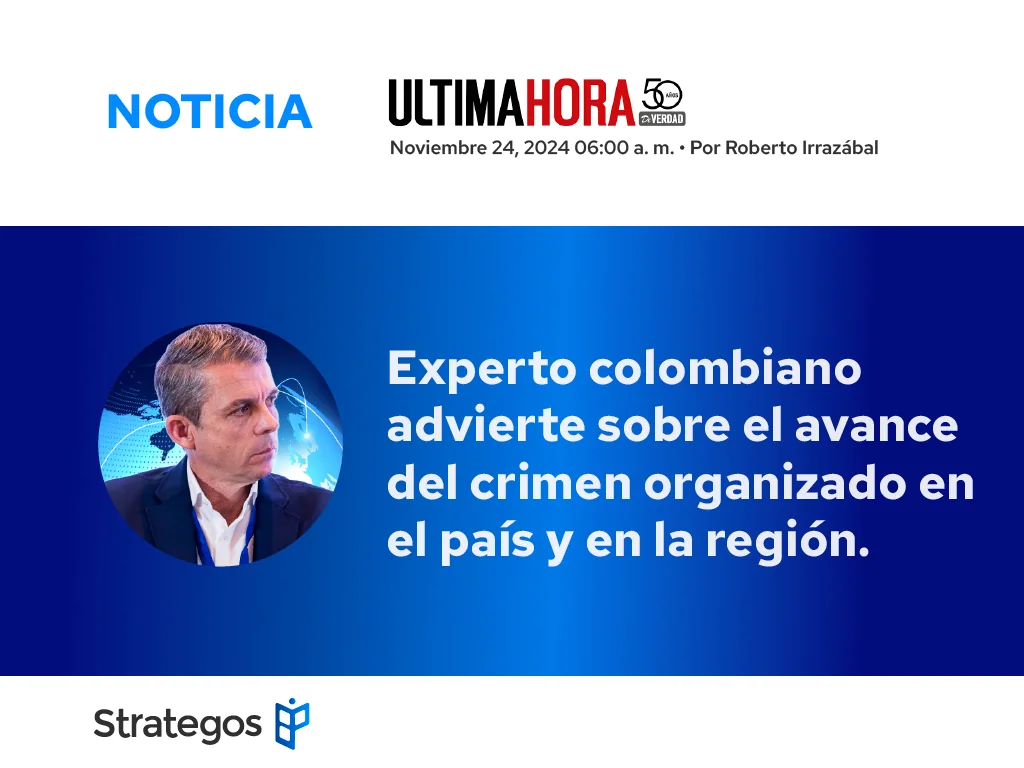
In an interview with ÚH, the retired general of the Colombian National Police, former director of Colombia's Fiscal and Customs Police, and founder and CEO of the consulting firm Strategos BIP, Juan Carlos Buitrago, gave his opinion on the critical outlook in the region, the growth of criminal groups and their increasing influence on politics and State bodies.
Regarding the situation of Horacio Cartes and the sanctions he received from the U.S. Government, he expressed his doubts about a change of stance under Donald Trump's new administration. Buitrago said that drug-trafficking and smuggling cartels are linked to the murder of prosecutor Marcelo Pecci.
–General, I'll ask you the question in the title of your book on corruption, criminality and violence. Will we be able to defeat the thousand-headed hydra?
–My answer is categorical: NO, as long as corruption continues to metastasize in power, the political machinery continues to govern, new leaderships allow themselves to be contaminated by petty politics, and the spiral of criminality and violence continues to be the perfect habitat for the hydra to regenerate in the region.
–Who are the main heads of this hydra, or what is the order of priority for combating them?
–Without a doubt, corruption. Where there is crime there is corruption, which is the main fuel for criminality, violence and institutional fragility to affect all of society comprehensively.
–What does this that you propose and call the “triangles strategy” consist of?
–The triangles strategy is a public-private initiative operating in Latin America and the Caribbean, whose objective is to prevent and combat illicit trade and organized crime in the region. It works by chapters: Northern Triangle, centered in Mexico; Central Triangle, in Panama; and Southern Triangle, in Argentina. Each Triangle is made up of customs, tax, judicial, police and border authorities, with industries of each country affected by illicit trade, and with the support of the OAS Department against Transnational Organized Crime, Ameripol, Interpol, Europol, the UN University for Peace, the Foundation for the Study of Money Laundering FELADE, U.S. HSI and other multilateral associations for the protection of legal trade and intellectual property. The great differentiator of this mechanism is that it integrates the efforts of the private sector, academia, multilateral organizations and authorities with a strategic, technical, regulatory and operational approach through the exchange of information for actionable, investigative purposes, in order to prevent and dismantle transnational criminal economies.
–How was CIMA (Illicit Trade Research, Monitoring and Analysis Centre) built to be the largest database on illicit trade in Latin America?
–CIMA has become the cutting-edge tool to contribute to the prevention and investigation of illicit trade and organized crime in Latin America and the Caribbean, and it is operated by a team of professionals, analysts and experts in intelligence, investigation, money laundering, illicit trade and organized crime. It also has artificial intelligence applications that contribute to a better understanding of, and action to mitigate, the phenomenon of illicit trade.
–How are these proposals progressing and who supports them? And if they have already had measurable results, what are they?
–CIMA's results are extraordinary. In two years of operation, multiple authorities, universities, multilateral organizations and private companies have access to and benefit from its products. We have contributed to the public and private sectors with multiple training sessions, exchange of best practices and structured information on the illicit trade chain of various products and the mafias that monopolize the criminal business and monetize drug-trafficking money and assets through smuggling or counterfeiting of products, including cigarettes, liquor, medicines, clothing, appliances, minerals, fuels, agro-industrial products and many others.
–How do you see Paraguay's role within the region and the existing scheme for fighting crime?
–Paraguay has significant development potential, but the thousand-headed hydra is embedded in the DNA of politics, the Justice system, the authorities and part of the private sector. I have had a very fluid relationship with top-level spokespeople who recognize these serious phenomena and who are moved by a deep national sentiment to contribute prompt and effective actions to eliminate that evil hydra. In my opinion, and the facts bear it out, drug trafficking is taking advantage of corruption, smuggling and marked institutional fragility to capture the State and subject it to its criminal interests. And the main symptom is the increase in violence and selective assassinations against leaders of the Justice system and the Government who do not negotiate their principles and fight with character and firmness against the country's most powerful mafias.
–What risk does the penetration of figures linked to organized crime into politics and State security bodies pose to the fight against it?
–As has happened in Colombia, Mexico, Ecuador and other countries in the region, when mafias capture political power, the essential purposes of the State are diverted, institutions metastasize and criminality exercises a perverse regulation that lets it accumulate power, money and territorial control. It then becomes very complex and costly to recover those lost spaces, as well as the integrity of officials and institutions.
Expert. Brigadier General (ret.) Juan Carlos Buitrago.
courtesy
–What is the relationship between the world of cigarette smuggling and drug trafficking and terrorism?
–The evidence has been categorical. A recent Europol study indicated it. Smuggling and production for illicit trade of cigarettes in Europe, Asia and Latin America have been directed especially toward money laundering by drug-trafficking organizations, which find in the countries most affected by this phenomenon a favorable niche to acquire volumes of cigarettes and insert them into the international market illegally, generating with this criminal economy various negative consequences in terms of tax collection, security, criminality and violence.
–With Donald Trump's victory, do you think there could be a change in the sanctions policy toward former president Horacio Cartes?
–The decisions of the United States on this matter, while they could have a political scope, have technical and legal bases and foundations supported by irrefutable evidence. It is the federal agencies that carry out the investigations and provide the body of evidence to the government leaders responsible for these decisions.
–What do you think about the situation in the murder case of prosecutor Marcelo Pecci?
–I am confident that the masterminds will be reached soon. All international justice has its eyes on the transparency, effectiveness and due process of Colombian and Paraguayan justice.
–What is the future in the region in the fight against organized crime?
–The specialized studies we read daily on organized crime in the region, not only those produced by the authorities but also by multilateral organizations such as UNODC, PACCTO, Interpol, Ameripol, Europol, and private research and think-tank institutions such as the Initiative against Global Crime (IGC), Insight Crime, StrategosBIP, Crime Stoppers, KPMG, TRACIT, all agree in presenting an exponential growth of corruption, criminality and violence in the region. All indicators place LATAM and the Caribbean in first or second place. Forty of the 50 most violent cities in the world are in the region, most of them in port and/or border areas of Mexico, Honduras, Colombia, Ecuador and Brazil, which indicates that drug-trafficking mafias are advancing in the fight to seize control of the international trade chain, so that they can export narcotics and import smuggled goods to launder that criminal money. As long as the corruption that has metastasized in power is not eradicated, we will hardly manage to eliminate the thousand-headed hydra, which has found in the region its perfect habitat to regenerate.
–What is your greatest fear regarding this tug-of-war between States and criminal groups?
–The existence of mafias embedded in the DNA of power, which act with an appearance of legality in illegality, without caring about the disastrous effect this has on the future of our nations, thus leaving a legacy without values or principles and a terrible reference for our young people, for whom obtaining easy and fast money and accumulating power ends up being the essence and reason for their existence. When the end justifies the means, society is on the verge of its extinction.
*Originally published in ULTIMA HORA. November 24, 2024, 6:00 a.m.:
https://www.ultimahora.com/sanciones-de-eeuu-tienen-base-tecnica-y-juridica-irrefutable
Juan Carlos Buitrago is a retired Brigadier General of the Colombian National Police. Former director of Colombia's Fiscal and Customs Police. Founder in 2020 and CEO of the regional consulting firm Strategos BIP. Author of several books.