
The Ecuadorian government wants to put out a fire with gasoline, and the question is not whether it will burn, but how badly it will burn. And who will be responsible for putting out the fire? On January 21, Ecuador's president, Daniel Noboa, announced a 30% tariff on imports from Colombia, a measure that took effect on February 1, 2026. The decision was justified by the lack of cooperation of President Gustavo Petro's government on border security (El País, 2026). The implications of this measure may be significant economically, even for border security, the monster it aims to fight.
The main immediate effect is the rising cost of the formal import channel. For importers, distributors and merchants operating within the law, the additional 30% translates into higher final prices and pressure on profit margins. On the other hand, informal traders not only experience no pressure on their costs, but also see the price gap between formal and informal channels widen, which encourages more people to buy smuggled goods.
The 586 kilometers of border between Colombia and Ecuador are made up of territories with high commercial interaction, constant flows of people and goods, and a local economy in which informality plays a functional role. In addition, these border territories suffer a strong presence of organized crime, including drug trafficking networks, illegal mining and the actions of armed groups such as FARC dissidents and the ELN (El País, 2026). These elements, together with institutional weakness, allow smuggling networks to exist, which do not arise as an isolated phenomenon but as a rational response to an environment where the cost of complying with the rules exceeds the perceived cost of evading them.
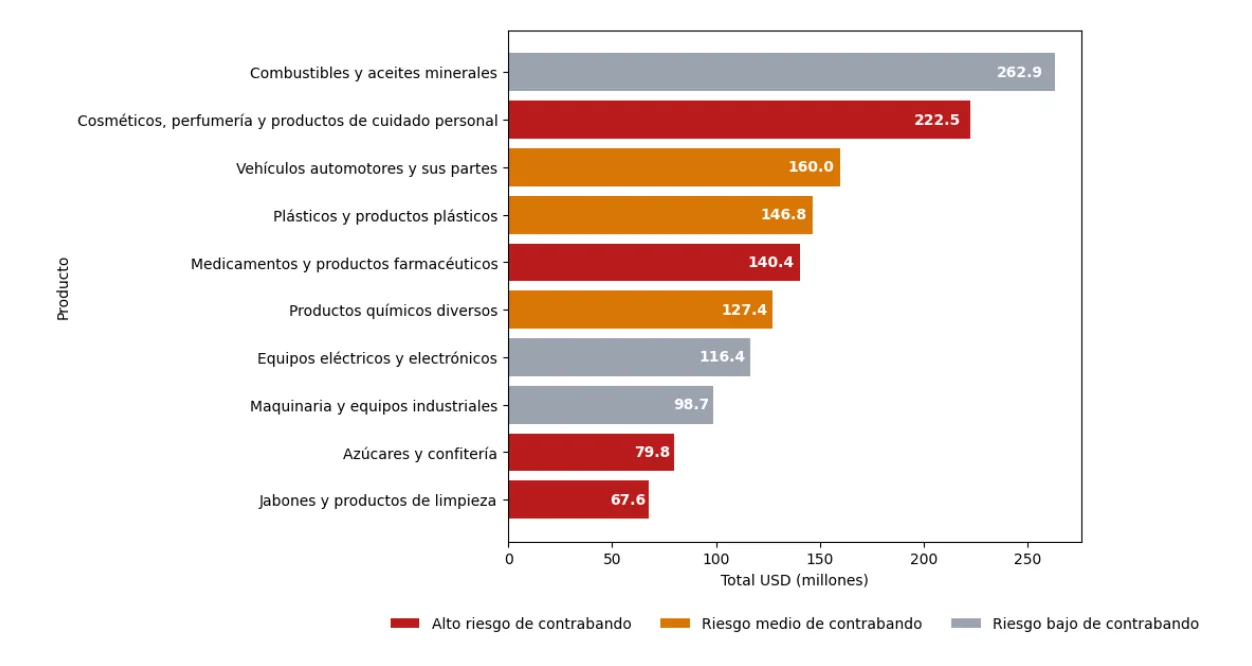
Looking at the products most imported into Ecuador from Colombia, a relevant risk of increased smuggling is identified in several of them. Within the top 10 are products such as cosmetics, medicines, candy and cleaning products, which combine significant demand volumes with high price sensitivity, making them particularly exposed to smuggling.
For their part, auto parts, plastics and various chemical products also appear among the main goods exported from Colombia to Ecuador; however, they present a medium risk of increased smuggling due to their lower relative demand and greater logistical barriers, although they are not exempt from this exposure.
Finally, industrial machinery, electronic equipment and fuels show a low risk of smuggling, associated with their high traceability and logistical complexity. However, these products can raise costs across various formal production chains, which face price increases and greater indirect exposure. Top 10 goods most imported into Ecuador from Colombia (Oct 2024–Oct 2025)
Smuggling, being an illegal economy with high returns, is not an isolated practice carried out by a few actors, but requires criminal structures and, in many cases, corruption schemes in order to operate. In this context, a measure designed to raise resources earmarked for security may end up indirectly strengthening informal economies and the criminal networks that sustain them. Smuggling does not need to replace formal trade to have significant impacts; it is enough for it to capture specific market segments to erode reference prices, weaken legal operators and reduce the effectiveness of the very public policy that sought to strengthen control.
The measure took effect in February and has already generated responses that raise bilateral tensions. Colombia suspended electricity sales to Ecuador and imposed 30% tariffs on Ecuadorian products. In parallel, Ecuador raised the fee for transporting crude oil through the pipeline by 900%, directly affecting Colombian oil exports. This exchange of measures, together with the tensions between both governments, increases the risk of escalation into a trade war, whose main victims would be formal logistics chains and, ultimately, consumers in both countries.
From an economic perspective, it is key that both nations comprehensively assess the risks associated with these decisions and steer their policies toward strengthening security without compromising the stability of formal trade. For companies exposed to the Colombia–Ecuador corridor, this scenario amplifies risks that go beyond a possible drop in sales: it increases the likelihood of diversions in distribution chains, intensifies competitive pressure from illicit channels and damages brand positioning through unfair competition practices.
In this context, risk management becomes a strategic priority. Reinforcing due diligence on third parties, adjusting distribution strategies in sensitive areas and monitoring early signs of informality in prices and supply is no longer merely preventive but necessary. The evidence suggests that, in this environment, the cost of not acting may far exceed the direct impact of the measure itself.
References
Ceballos, M., & Ardila, G. (2016). The Colombia–Ecuador border region: Between informal dynamics and illegal practices. Journal of Borderlands Studies, 30(1), 1–17. https://doi.org/10.1080/08865655.2016.1179208
El País. (2026, January 21). Ecuador anuncia aranceles del 30% contra Colombia por falta de cooperación en seguridad. https://elpais.com/america-colombia/2026-01-21/ecuador-anuncia-aranceles-de-30-contra-colombia-por-falta-de-cooperacion-en-seguridad.html
LegisComex. (2025). Estadísticas de comercio exterior Ecuador–Colombia. https://www.legiscomex.com