Why is the First Half 2025 Report on the Global Panorama of Criminal Economies so relevant?
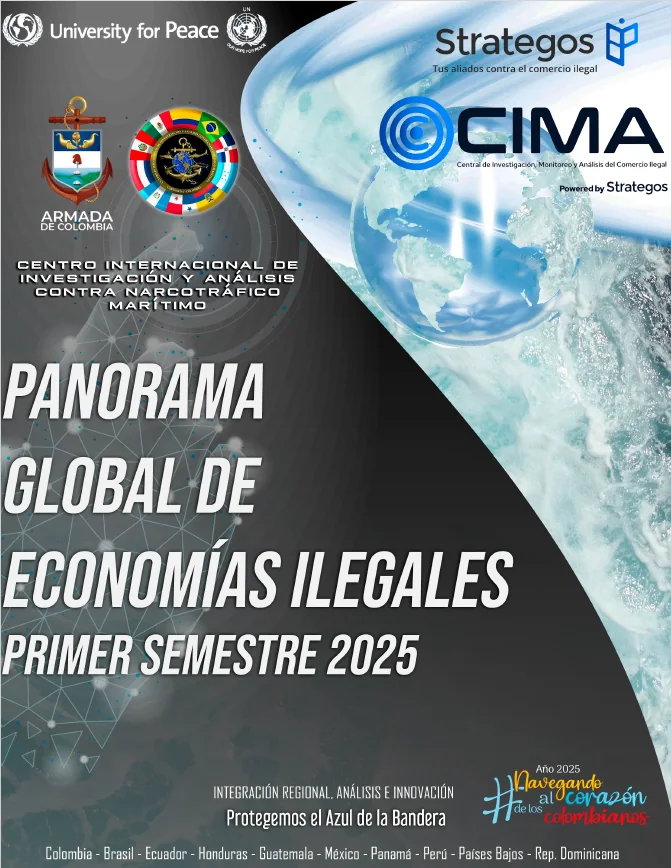
This new edition of the report, promoted by the International Center for Research and Analysis against Maritime Drug Trafficking (CMCON), the Colombian Navy, the University for Peace (UPEACE) and Strategos BIP, offers an up-to-date x-ray of the illicit dynamics affecting Latin America and the Caribbean.
At Strategos BIP we had the honor of contributing our analysis and data, within an intersectoral collaboration that we consider indispensable for confronting these challenges. But why is this effort so important? Here are three key reasons:
1️⃣ Because it breaks myths: organized crime in the region is not only drug trafficking.
Smuggling, product counterfeiting and the illegal trade in medicines, alcohol or tobacco are high-impact criminal economies that are often underestimated, but that feed transnational networks and erode legality from the local level.
2️⃣ Because it reinforces the value of public-private collaboration.
This report is a concrete example of what we can achieve when States, civil society, academia and the private sector come together with a common purpose. Only with real and sustained alliances will it be possible to confront these complex, cross-border networks.
3️⃣ Because it shows that access to public information is a powerful tool.
Today, thanks to open sources and advanced analysis methodologies, non-state actors can also help track and understand these phenomena. At Strategos BIP, we do so through our monitoring and analysis platform CIMA, which in the first half of 2025 recorded more than 500 operational illicit trade events in the region, with a special focus on tobacco, alcohol and medicines.
These data reflect not only the magnitude of the problem, but also its territorial and economic sophistication. Illicit routes cross borders, challenge control capacities and require comprehensive, informed responses.
📥 Download the full report here:
We thank our allies once again for this valuable opportunity for cooperation. Spaces like this are essential to generate rigorous knowledge, share best practices and strengthen the regional capacity to understand, track and confront illicit trade.