
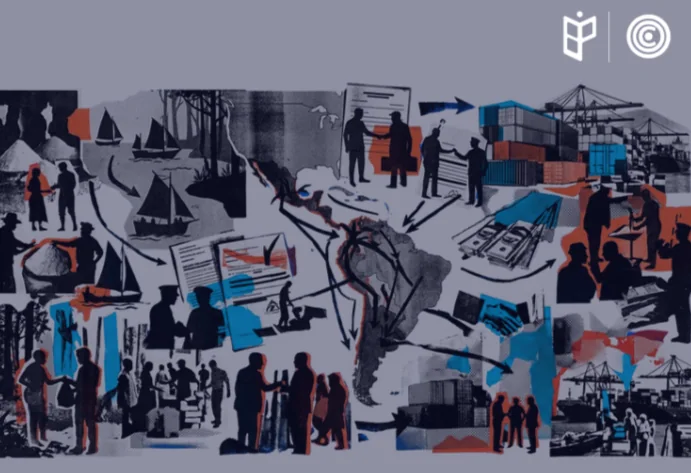
As old as the first tax systems, smuggling is a millennia-old practice that remains in force and shows no sign of dying out. And smuggling is not just one thing; it is a diverse set of illegal economic practices that endure and reshape themselves as economic regulations change. Throughout history, every regulatory framework has met its response in practices that seek to evade it: “every law has its loophole.” This article explains what smuggling is, how it has evolved, what forms it takes today and why it still has such a profound impact on modern economies.
According to the Royal Spanish Academy (RAE), smuggling is the “introduction into a country or export of goods without paying the customs duties to which they are legally subject.” Besides involving tax fraud, selling these goods means selling illegal products; therefore, from the moment they enter the country, the whole chain is a completely irregular and illicit value chain. There are two types of smuggling: open and technical, which I explain below.
Open smuggling refers to cases in which goods enter without being declared, usually through unauthorized crossings or routes with no control at all (or with rigged control). This type goes beyond simply entering through unauthorized points; being the most irregular, it tends to be associated with criminal organizations that carry out other criminal activities such as money laundering, illegal arms trafficking and possession, and extortion, among others. Technical smuggling, on the other hand, refers to goods that enter through formal channels, in plain sight of customs authorities, but with manipulated information in order to reduce taxes. Examples include under-invoicing, which consists of declaring prices lower than the real ones in order to pay less tax, and tariff-heading changes, which involve importing a good by declaring it under another heading with a lower tax burden.
The history of smuggling is, to a large extent, the history of how societies have tried to get around economic restrictions. Every time a State imposed a monopoly or an excessive tax, a clandestine route emerged to break it. In pre-modern Europe, for example, salt was so heavily taxed that its illegal trade ended up forming entire networks capable of moving goods at night, through forests and secondary rivers, far from tax collectors. With colonial expansion, the phenomenon took on a different scale: American ports, forced to trade only with the mother country, were cut off from the rest of the world. That gap was filled by merchants who began receiving English textiles, French liquors and Dutch goods that never passed through the official records. What today we would call smuggling was, for many inhabitants, the only way to access goods that regulation had made scarce or prohibitively expensive.
In Latin America, this logic persisted after independence. The new States inherited vast borders, little capacity for control and an urgent need to raise revenue, which led to high tariffs on almost everything imported. The result was predictable: the same routes that once moved tobacco, sugar or cacao began to bring in weapons, European fabrics, liquor and manufactured goods that bypassed the formal ports. In remote regions, where the State's presence was more symbolic than real, smuggling ended up integrating into everyday economic life. More than a marginal activity, it became a mechanism for getting around policies that did not always respond to local needs. That mix of rigid regulation, high taxes and wide institutional gaps is what ended up giving smuggling the persistent role it has had in the region's history, although today there is no longer any justification: today smuggling does not respond to scarcity or isolation, but to networks that seek to evade taxes and compete unfairly in fully integrated markets.
Although its origin is tied to very different historical contexts, today smuggling is sustained by concrete reasons: given the tax burden, this practice is attractive not only to the smuggler, who considerably reduces his costs, but also to the consumer, who finds lower prices than in formal commerce. That combination explains its persistence, even though its economic and social effects are deeply negative. The Latin American Anti-Smuggling Alliance (ALAC) estimates that illicit trade and smuggling in Latin America move more than US$210 billion a year, about 2% of regional GDP. This volume affects the public sector through lost revenue, weakens the competitiveness of the private sector and exposes consumers to products that, in many cases, do not meet basic health or quality controls.
Smuggling persists because it fits into the real gaps and tensions of Latin American economies: tax systems that create distorted incentives, income gaps that make any immediate saving attractive, and institutional capacities that advance more slowly than the illegal networks seeking to circumvent them. It is not an isolated phenomenon, nor a strictly customs-related one; it is a symptom of structural failures that repeat across the region. Understanding it through its economic, regulatory and institutional dimensions helps explain why, even with stronger controls, it still occupies such a large space in trade. It also shows that tackling it is not solved by seizures alone, but by correcting the incentives that feed it and strengthening the institutions that today fail to contain it. Public-private coordination is important, with initiatives such as the Triangles Strategy of Strategos BIP.