
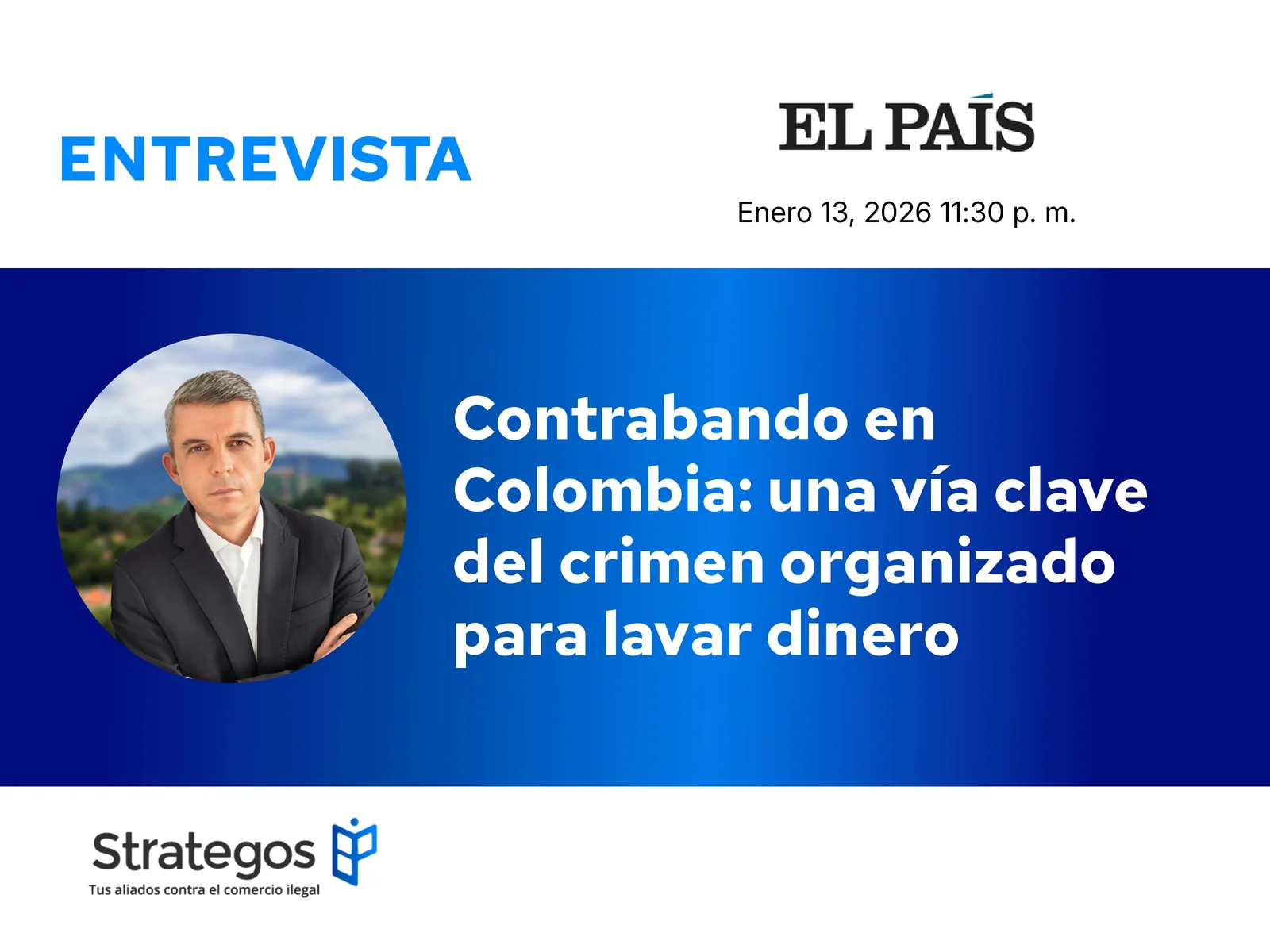
Smuggling in Colombia continues to consolidate itself as one of the main risks to the country's economic security and institutional stability. According to recent figures from the National Tax and Customs Directorate (DIAN), this activity generates tax losses of more than eight trillion pesos a year, and about 15% of the goods entering the national territory do so undeclared.
However, the challenge is not limited to the tax impact. For General (ret.) Juan Carlos Buitrago Arias, former director of the Fiscal and Customs Police (POLFA), CEO of Strategos BIP and coordinator of the Triangles Strategy, smuggling has become a central tool of organized crime for laundering assets, financing illegal economies and sustaining transnational criminal networks.
Outdated Measurement and Structural Lags
One of the main obstacles to confronting smuggling is the limited capacity for real-time measurement. Colombia's official method is based on comparing foreign trade data reported by third countries with locally recorded imports, a process that can take up to 24 months to consolidate.
A methodological pilot implemented in 2023, which incorporated advanced statistical sampling and expanded coverage of trading partners, made it possible to identify that the real distortion caused by smuggling reached 14.7%. However, this technical advance was subsequently suspended, reducing the State's analytical capacity in the face of a highly dynamic phenomenon.
Smuggling and Organized Crime: An Integrated Criminal Economy
According to General (ret.) Juan Carlos Buitrago Arias, smuggling no longer operates as an isolated crime but as part of an integrated criminal economy that links drug trafficking, illegal mining, institutional corruption and money laundering. Illegal networks use maritime, air and land routes, combined with urban warehouses and digital platforms, to insert illegal goods into the formal market.
From the Illicit Trade Research, Monitoring and Analysis Centre (CIMA) of Strategos BIP it has been documented how these structures use international triangulation mechanisms, cryptocurrencies and technical smuggling schemes —undervaluation and fraudulent classification of goods— which today account for about 90% of the customs fraud detected in Colombia.
Strategic Ports and Critical Nodes of Illicit Trade
The country's main ports, such as Buenaventura, Cartagena, Santa Marta and Barranquilla, have become key points for the entry of illegal goods. Cities such as Cali and Bogotá concentrate record volumes of intercepted merchandise, which shows the centrality of logistics and urban corridors in the operation of these networks.
Although the number of seizures has declined in recent years, the economic value of the confiscations has increased, reflecting a larger illicit market and more sophisticated operations.
Institutional Challenges and the Need for Modernization
Experts agree that confronting smuggling requires a structural transformation of control systems. Among the main priorities are:
Implementation of artificial intelligence and Big Data analysis for risk profiling.
Technological modernization of control agencies.
Strengthening of international cooperation.
Institutional cleansing to reduce risks of criminal infiltration.
Public-private partnerships aimed at protecting logistics chains.
In addition, the sustained drop in judicial proceedings and convictions for smuggling has weakened the deterrent effect of the criminal justice system, favoring the expansion of these illegal economies.
Beyond Customs: An Economic Security Problem
Smuggling in Colombia must be understood as a phenomenon of economic security and criminal governance. As noted by General (ret.) Juan Carlos Buitrago Arias, where systematic smuggling exists, there are also corruption networks that facilitate its operation.
In this context, strengthening economic intelligence, strategic monitoring and data analysis capabilities —such as those developed by CIMA at Strategos BIP— is key to anticipating risks, protecting legal markets and reducing the structural impact of illicit trade in the country.
Source: this is a summary of the news story originally published in the newspaper El País by Juan Pablo Quintero on January 13, 2026.
Read the full story here: https://elpais.com/america-colombia/2026-01-14/colombia-retrocede-en-sus-esfuerzos-por-medir-mejor-el-contrabando.html