
V High-Level Meeting of the Triangles Strategy - Southern Triangle Chapter in Buenos Aires

July 1 and 2, 2025, Buenos Aires, Argentina

At the invitation of the Ministry of National Security of the Argentine Republic, the Department against Transnational Organized Crime (DDOT) of the Organization of American States (OAS) and Strategos BIP, the V High-Level Meeting of the Triangles Strategy, Southern Triangle Chapter, was held on Tuesday, July 1 and Wednesday, July 2. It brought together representatives of authorities from Argentina, Bolivia, Brazil, Chile, Colombia, the United States, Japan, Panama, Paraguay, Peru and Uruguay, with the participation of 61 government institutions, international organizations, universities and companies. The forum had approximately 123 participants, both virtual and in person.
This meeting was supported by international organizations such as the OAS, OAS-DDOT, AMERIPOL, GAFILAT, INTERPOL, UPAZ, as well as multiple key allies such as AIPPI, COLADCA, Estrategia Jurídica, ESEM, FBINNA, FELADE, ICC Institute of World Business Law, TRACIT and Universidad Hemisferios; and key allies such as: AIPPI, AMERIPOL, COLADCA, EUROPOL, Estrategia Jurídica, ESEM, FELADE, ICC Institute of World Business Law, INTERPOL, Universidad Hemisferios, University for Peace (UPEACE) and TRACIT. This event represented a crucial opportunity to effectively address, at the regional level, the problem of illicit trade in various products, both at the strategic and operational levels.

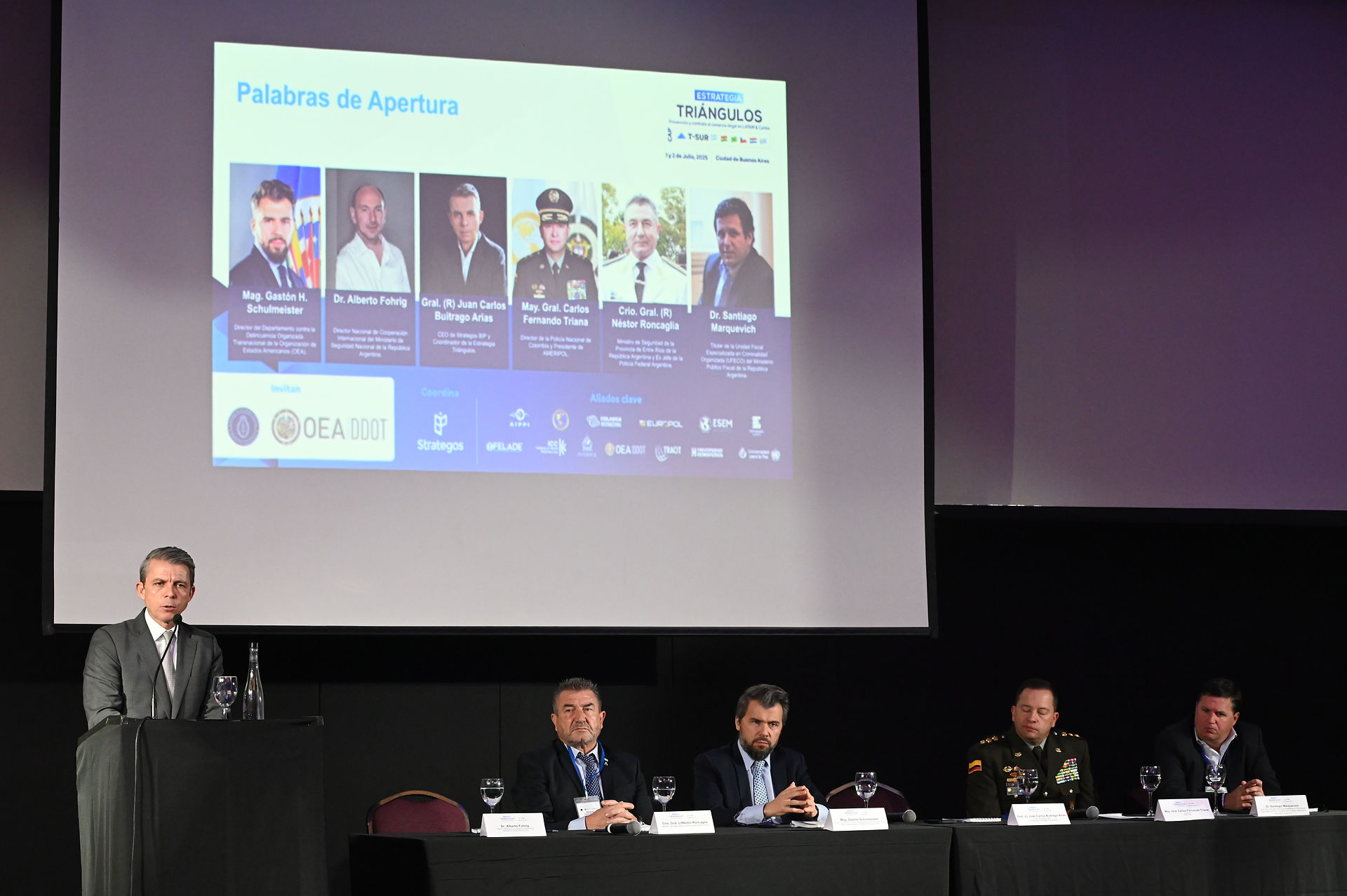


The meeting began with welcoming remarks from Dr. Alberto Fohrig, National Director of International Cooperation of the Ministry of National Security of the Argentine Republic; from Mag. Gastón Schulmeister, Director of the Department against Transnational Organized Crime of the Organization of American States; from Gen. (ret.) Juan Carlos Buitrago, CEO of Strategos BIP and Coordinator of the Triangles Strategy; from Maj. Gen. Carlos Fernando Triana, Director of the Colombian National Police and President of the Police Community of the Americas (AMERIPOL); from Commissioner General Néstor Roncaglia, Minister of Security of the Province of Entre Ríos, Argentine Republic; and from Dr. Santiago Marquevich, Head of the Specialized Prosecutorial Unit on Organized Crime (UFECO) of the Public Prosecution Service of the host country, who highlighted the current problem posed by illicit trade and the importance of both sectors coming together for the frequent exchange of experience and information.


Likewise, during the day Dra. Patricia Bullrich, Minister of National Security of the Argentine Republic, gave remarks on the Ministry's vision of illicit trade in the region and the efforts and strategies it has implemented to make Argentina a safer country. The senior official mentioned that the UN positions Argentina as the country with the lowest violence and homicide in the region, given that the efforts of the Ministry of Security have led to “after a year and a half we cut homicides by 65%. Our rate is lower than the national one, and that means a combination of elements that achieved a relentless fight against criminal organizations that seemed to dominate the territory of Santa Fe,” the minister stated.
Panels of the Day


On the part of the region's authorities, the first panel discussed Regional strategies against illicit trade and its relationship with money laundering, corruption and criminal incentives in the countries of the Southern Triangle, moderated by Mr. Esteban Fullin, Executive Secretary of the Financial Action Task Force of Latin America (GAFILAT), with panelists representing the Investigative Police of Chile, Interpol, the Foundation for the Study of Money Laundering and Crime (FELADE) and the Transnational Alliance to Combat Illicit Trade (TRACIT). This panel focused the conversation on highlighting the regional plans and strategies that exist today to combat illicit trade. The importance of information-sharing policies between the public and private sectors for investigative purposes was highlighted, as was the need to raise awareness of the effects of illicit trade on society.

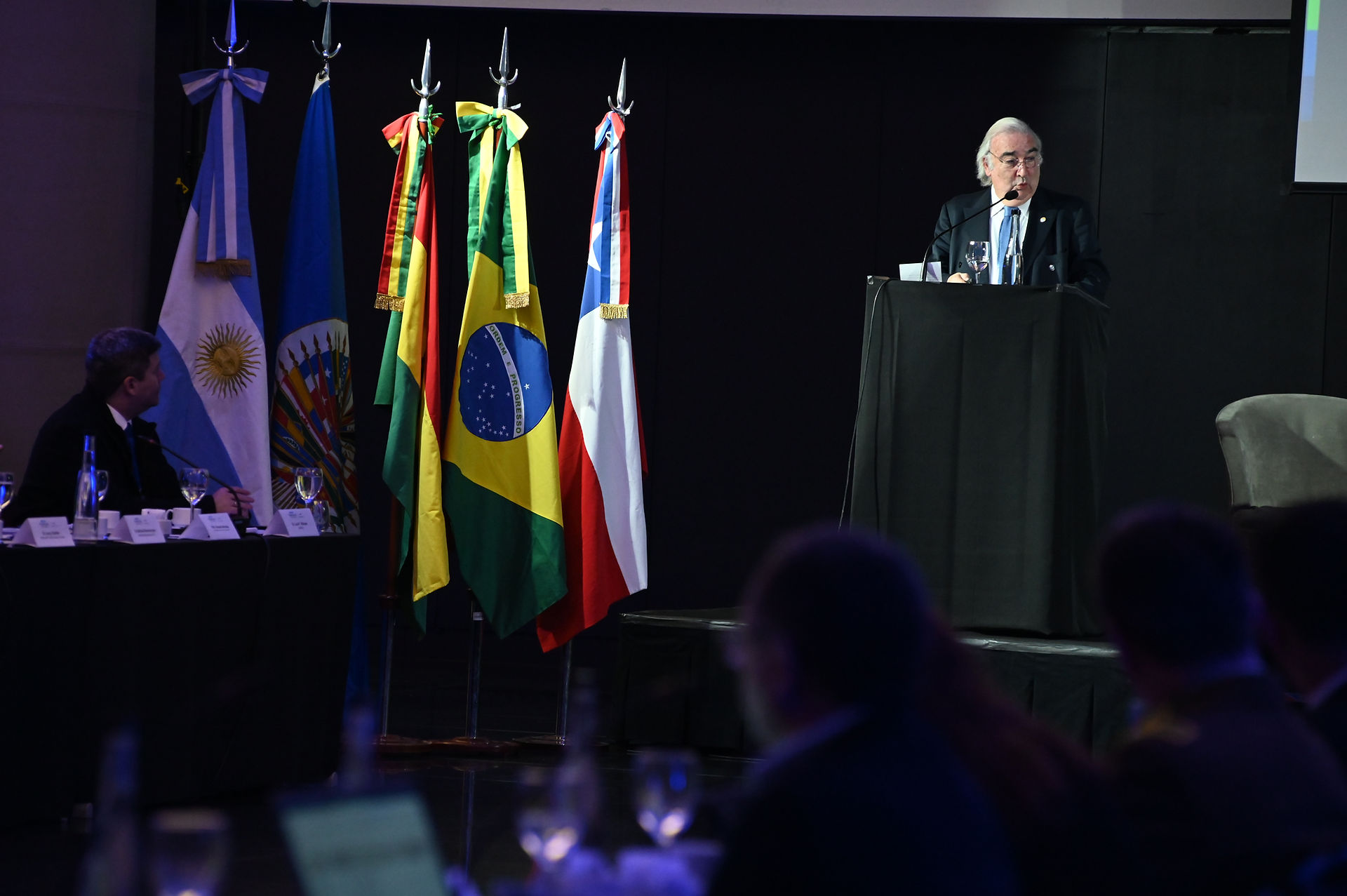

Subsequently, the floor was given to Dr. Francisco Rojas, Rector of the United Nations University for Peace, who offered a perspective on the growing impacts of transnational organized crime and illicit markets, as well as their relationship with global conflict and the weakening of democracies.


The second panel, titled The Tri-Border Area Case and the importance of international cooperation in combating illicit trade, was moderated by Prof. Evan Ellis of the Inter-American Defense College (IADC). It focused on discussing the nature of the Tri-Border Area as the geographic space where commercial flow occurs between Argentina, Brazil and Paraguay, and how its porosity allows one of the region's major hotspots of smuggling and terrorist financing. Representatives of Brazil's Federal Revenue Service, Brazil's Public Prosecutor's Office and the Organized Crime Investigation Directorate of Paraguay's National Police took part.


On behalf of Strategos BIP, COO Juan Ruiz, addressed the foundations and possible solutions that the economies and governments of the different Latin American countries need today. One of these solutions is the CIMA platform, an information tool that allows States to collect essential data for conducting investigations in the prevention and combat of illicit trade.


In the third panel, titled Regulatory Frameworks and comprehensive institutional capacities to mitigate illicit trade and combat organized crime, moderated by Mr. Juan Ignacio Cánepa, Academic Secretary of the TAEDA Foundation, the regulatory frameworks currently established in the countries of the region to combat and mitigate illicit trade and organized crime were discussed. This panel included members of Argentina's Secretariat of National Security, the Argentine Federal Police, the Uruguayan National Police, as well as Argentina's Prosecutor's Office and Federal Court.


Finally, on the private-sector side, in the panel Multi-industry vision. Lessons learned and areas of opportunity, moderated by Dr. Víctor Guerra, Global Chair of the Compliance Task Force of the ICC Institute of World Business Law, regional and international cooperation efforts against illicit trade were addressed from the industries' perspective. Representatives of Philip Morris International (PMI), Diageo, Syngenta, ITAS and the law firm Mitchell Barrenechea took part.
Dialogue Table and Roadmap
Lastly, Gen. (ret.) Juan Carlos Buitrago, CEO of Strategos BIP, and Mag. Gastón Schulmeister, Director of OAS-DDOT, moderated the dialogue and summarized the most relevant considerations presented during the day. In this context, an operational route was proposed to support authorities and other actors in the mission of preventing and combating illicit trade in the region. It was reflected in a Declaration of intent with concrete objectives, such as the visit to the Tripartite Command in the Tri-Border Area with the support of Paraguay's Ministry of Justice; the invitation to take part in the VI High-Level Meeting – Northern Chapter in Mexico, at the end of the year; making the CIMA Platform available to authorities and industries as an operationalization mechanism; an upcoming training for different authorities in Chile in light of the growing problem of illegality in industries such as alcoholic beverages or pharmaceuticals; and the invitation to a meeting in Switzerland to discuss different strategies for preventing and combating the illicit trade in tobacco products.
Day 2


The following morning, attendees held an executive dialogue with Dr. Martín Verrier, Secretary for the Fight against Drug Trafficking and Organized Crime of the Ministry of National Security of the Argentine Republic, and an executive presentation by Prefect General (ret.) Ricardo Blanco on the capacities for preventing and controlling illicit cargo at Puerto Exolgan.
Subsequently, participants took part in a guided visit by the Revenue Collection and Customs Control Agency (ARCA) to Puerto Exolgan, where attendees could observe the port's operation first-hand. They also visited the Customs Museum, where they took a guided tour with museum staff and expanded their knowledge of customs operations and history. The day ended with closing remarks from the OAS and Strategos BIP, as well as from ARCA.
Participating entities:
Authorities
Argentina: Revenue Collection and Customs Control Agency, Supreme Court of Justice, Chamber of Deputies of the Nation, National Institute of Industrial Property, Public Prosecutor's Office, Ministry of Justice of the Nation, Ministry of National Security, Minister of Security of the Province of Entre Ríos, Public Fiscal Tribunal.
Bolivia: Financial Investigations Unit.
Brazil: Public Prosecutor's Office, Federal Police, Federal Reserve of Brazil.
Chile: Carabineros de Chile, Ministry of Public Security of Chile, Investigative Police, National Customs Service, National Consumer Service.
Colombia: Colombian National Police
United States: Inter-American Defense College, CBP and HSI of the Department of Homeland Security (DHS)
Japan: JETRO
Peru: National Police
Uruguay: National Police
International organizations:
OAS, OAS-DDOT, AMERIPOL, GAFILAT, INTERPOL, UPAZ.
From the private sector and academia:
ASIPI, Asociación Civil Antipiratería Argentina, Aduana News, AcquaConsult S.A., AMASSURU, CERTAL, Chamber of Industry, Commerce, Services and Tourism of Santa Cruz (CAINCO), National Chamber of Commerce, Consultora Landa Durán, Diageo, DP World, Exolgan Container Terminal, FBINNA, Foundation for the Study of Money Laundering and Crime, Fidelem Security Advisors, FinLaw Association, FNCP, TAEDA Foundation, ICC Institute of World Business Law, Laboratorios Bagó de Bolivia, MF Brands, Marval O’Farrell Mairal, Mercado Libre, Philip Morris International, Strategos BIP, Sanofi, Syngenta, TRACIT, Wildlife Conservation Society.
Download the full Report here:

The Triangles Strategy is a strategic and operational public-private alliance to combat illicit trade and organized crime in Latin America and the Caribbean. We thank the key allies that are part of this initiative:
Hemisferios University School of Government
For more information:



Comments